

Services · Agentic AI

Agents that finish the work — and know when to stop and ask

Our Agentic AI system plans, calls your tools, and completes multi-step work — with a human able to step in at any checkpoint you choose. We build and operate these agents for teams that want the throughput without betting the process on it.

Built from scratch, any model
  • LangGraph
  • Claude Agent SDK
  • OpenAI Agents SDK
  • Cursor SDK
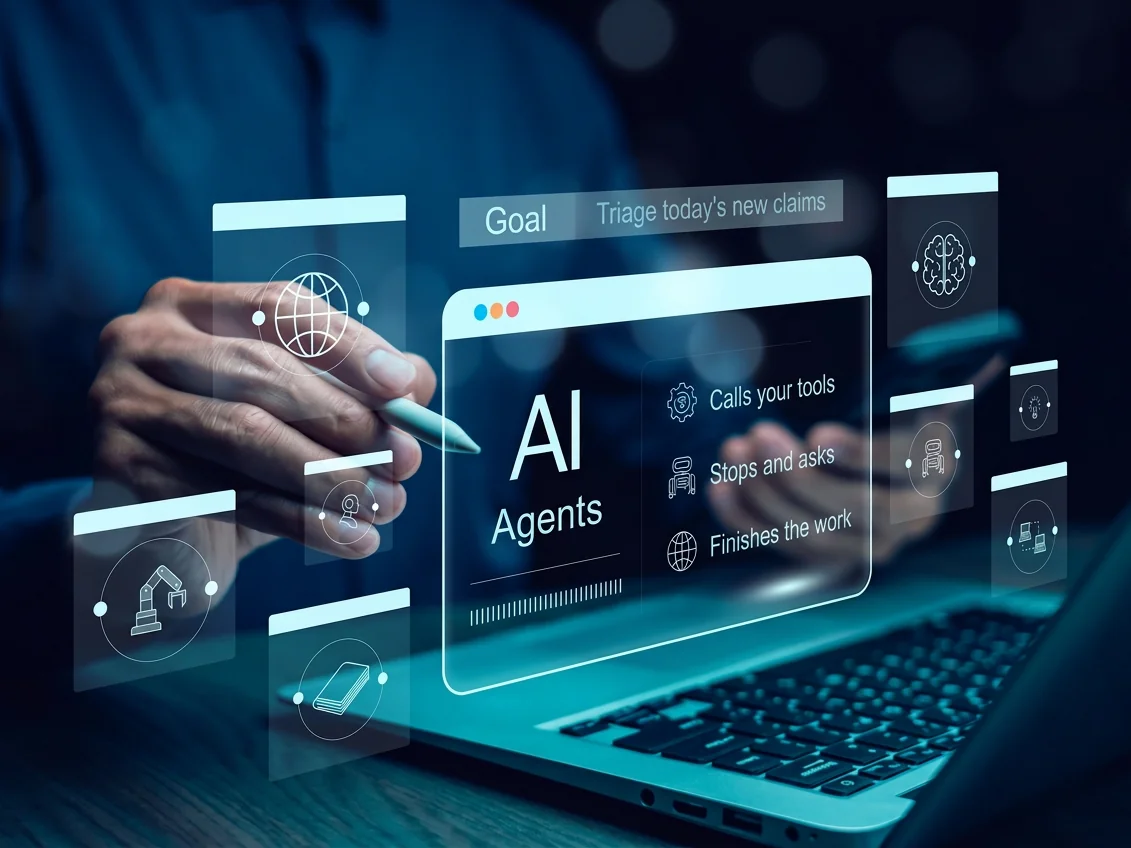
A person with a stylus at a laptop, facing a floating AI Agents panel: the goal Triage today's new claims, then Calls your tools, Stops and asks, and Finishes the work
Every decision logged what the agent did, which tool it called, and why — retained for audit
The same agent, two paths

Finishing and stopping are both success

Every run either clears each check and settles itself, or holds for a person. Which path a run takes is a threshold you set — not a surprise you discover in production. Here are both paths in one claims workflow.

Settle without a humanClears every check, closes itself

Under the auto-approve threshold, full policy match — settled and logged.

Hold for an adjusterStops before it acts, waits for sign-off

Over threshold or low confidence — waits for a named approver before it acts.

How an agent engagement runs

Most engagements follow the same shape — small scope first, proven before it scales.

1

Discovery

Two weeks to pick the single highest-leverage workflow — not a wishlist, one workflow worth automating first.

2

Pilot

A production pilot scoped to one team, with evals and guardrails built in from day one, not bolted on after launch.

3

Wider rollout

Once the pilot holds up against real cases, roll out wider — same checkpoints, same audit trail, more workflows.

What's inside Agentic AI

Five practices, one checkpoint discipline

Not a sequence — pick whichever maps to what you're automating. Each one plans, acts, and knows exactly where to stop and wait for a person.

Scoped to one workflow

Custom AI Agents

We design and build agents scoped to a single high-leverage workflow first — not a general-purpose assistant that does a bit of everything passably. Each agent plans its own steps, calls your APIs and internal services with typed inputs and outputs, and hands off to a human at whichever checkpoint the cost of a mistake outweighs the cost of a delay.

Where you're already standardized on an enterprise platform, we build there directly — Salesforce Agentforce, Microsoft Copilot Studio, Azure AI Foundry — instead of routing everything through a bespoke framework you then have to maintain yourself. Where no platform fits the workflow, we build framework-agnostic from scratch.

  • Customer support triage — classify, enrich and route (or resolve) inbound tickets in seconds
  • Claims and document processing — structured data extracted straight into your systems of record
  • Sales and RevOps copilots — draft outreach, update the CRM, flag at-risk accounts
  • Internal knowledge agents — one place to ask questions across scattered wikis, tickets and codebases

Hands at a keyboard in a dim office, source code and notes on the desk

An agent is a service account with credentials and a job description. We scope it to one workflow, give it typed tools, and put a person on the decisions worth a person.

Salesforce Agentforce Microsoft Copilot Studio Azure AI Foundry Framework-agnostic
Supervisor / specialist

Multi-Agent Orchestration

Some work is too complex for a single prompt or a single agent. We build specialist agents — research, drafting, QA — coordinated by a supervisor that breaks the task down, routes it to the right specialist, and checks the result before it moves on.

  • Supervisor/specialist agent architectures for multi-stage work
  • Typed handoffs between agents, so failures are traceable to a specific step, not a black box
  • Rate limits and spend caps on tool use, tuned per agent
  • Designed to degrade gracefully — a single agent failing doesn't take down the whole pipeline
Supervisor and specialist agent architecture Supervisor splits the task, checks each result Research gathers sources Drafting produces the work QA checks it holds up typed handoff — a failure is traceable to one step, not a black box
Each specialist returns a typed result rather than free text, so when something goes wrong you get the step that failed instead of a pipeline that silently produced the wrong answer.
When the path isn't fixed

Agentic Workflows

Beyond a single agent, we automate the workflow around it — the multi-step handoffs across systems that used to mean someone re-typing the same data three times. An agent plans and executes across several systems in one pass, without losing the audit trail a human process would have had. This is the right shape when the route cannot be drawn in advance — the next step depends on what the last one found, and the checkpoint is where a person takes it back.

  • Multi-step task agents that execute across several systems without a human re-typing data at every handoff
  • DevOps and SRE automation — agents that triage alerts, correlate logs, and propose (or execute, with approval) the fix
  • Configurable human-in-the-loop checkpoints, so nothing customer-facing or financially sensitive ships without sign-off
  • Built on your existing systems of record — not a parallel database the agent maintains on its own
Where a checkpoint sits in an automated workflow Trigger ticket / claim Agent plans decides the steps and their order tool calls check- point under threshold completes over threshold waits for approval
Both paths write to the same audit log. Moving the checkpoint is a config change, not a rebuild — which is how a pilot widens without a second engagement.
When the path is fixed

AI-Powered Automation

Not every process needs an agent. When the route is already known and stable — intake, read, check, decide, post — the honest answer is a deterministic pipeline with a model doing the reading and the judgement inside it. It costs less per run, every step is testable on its own, and the behaviour doesn't drift between releases. We build these too, and we'll tell you when it's the better shape than an agent.

  • Document-heavy processing — invoices, claim forms, KYC packets — read into the typed fields your systems already accept
  • Classification and routing on a fixed path: the pipeline decides where it goes, the model decides what it is
  • Straight-through processing for the routine majority, with anything that fails a rule going to a named person — not a retry loop
  • A replacement for brittle RPA scripts that broke every time a form, a screen or a vendor template changed
A fixed pipeline with model-powered steps ONE ROUTE, FIXED IN CODE intake form + photos extract reads it validate your rules decide routine? post system of record code model code model code fails a rule → exception queue (a named person)
Two of the five steps are model-powered; the route between them is ordinary code your team can read. That's the trade — less adaptable than an agent, and far easier to test, price and certify.
Built in, not bolted on

Evals, Guardrails & Observability

Agentic systems fail quietly when nobody is watching the tool calls. We treat evaluation and guardrails as part of the build, not an afterthought: every agent ships with test suites against real historical cases, rate limits and spend caps on tool use, and full audit logs of what it decided and why. The same zero-trust practices that run the rest of your stack apply here too — an agent is a service account with credentials, and we design it like one.

  • Test suites evaluated against real historical cases before an agent ships
  • Full audit logs of every decision and tool call
  • Rate limits and spend caps enforced at the tool-call level
pre-flight · claims-agent v2.4
Eval suite — 1,240 historical claims replayed 96.4% match
Tool permissions — scoped, read-only outside settlement enforced
Spend cap — per run and per day enforced
Settlement over threshold — requires named approver holds
An agent doesn't ship until it clears its own pre-flight. The last line is a guardrail, not a failure — holding is the behaviour we want.

Let's scope your agent

Our discovery phase tells you which workflow to automate first, and what it takes to ship it safely.